← worksCourse project · NLP202520/20
Politeness classification, from SVMs to LoRA
Four-way politeness classifier on Intel's Polite Guard, from Word2Vec baselines to RoBERTa, PEFT and LLM prompting.
PyTorchHF TransformerspeftW&B
With Félix Martins and Francisco da Ana · Natural Language Processing, FEUP/FCUP
Intel's Polite Guard dataset labels customer-service text as polite, somewhat polite, neutral or impolite. Over two assignments we climbed the whole ladder: sparse features and SVMs, transformer fine-tuning, domain adaptation, parameter-efficient adapters, and finally prompting LLMs.
Phase 1: traditional ML
- Bag-of-words, TF-IDF and dense Word2Vec features across dozens of hyper-parameter configurations.
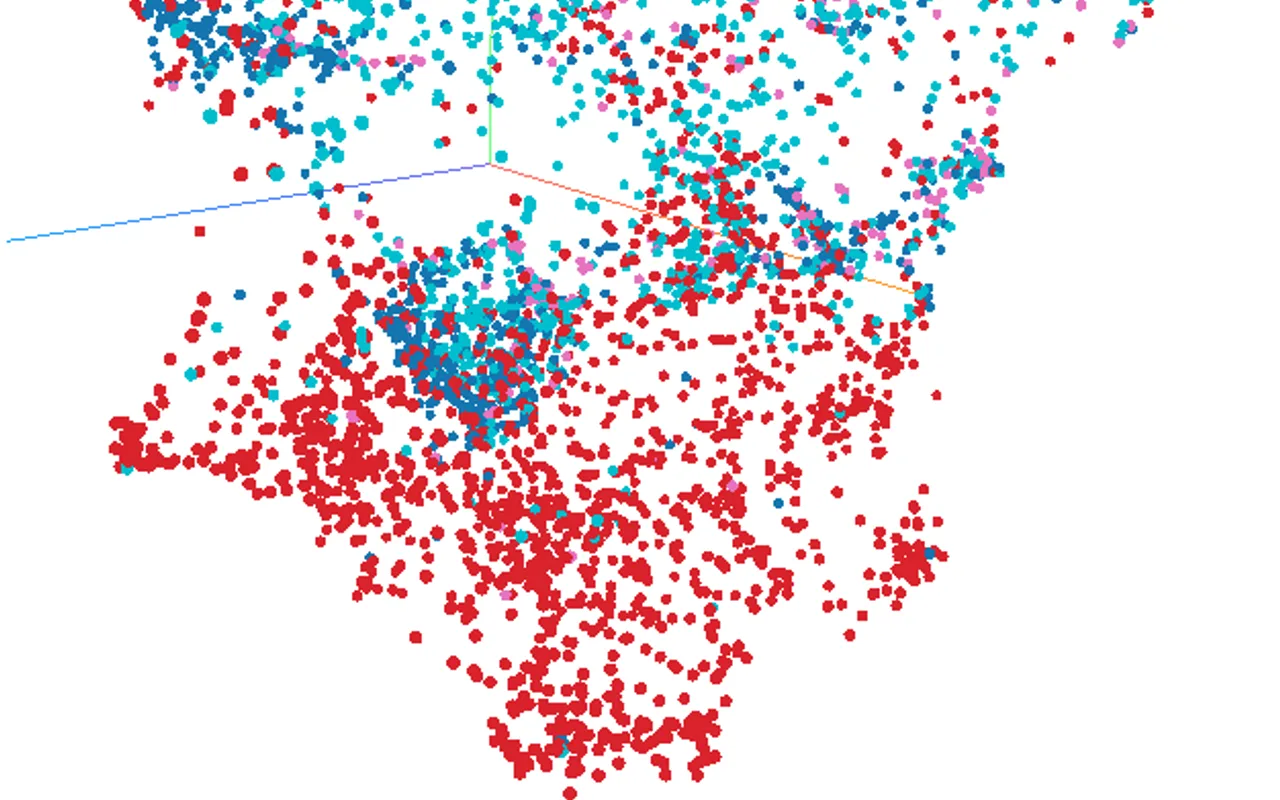
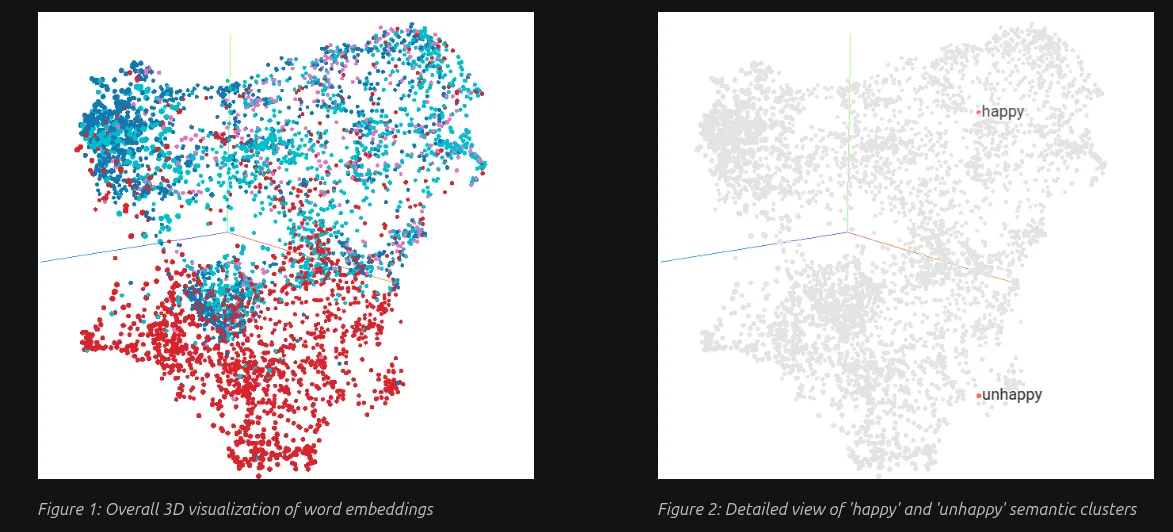
- Word2Vec embeddings visualised in 3D with TensorBoard and UMAP showed clean semantic clusters ("happy" vs "unhappy").
- Best baseline: SVM + Word2Vec, 88.5% F1.
Phase 2: transformers
- Fine-tuned
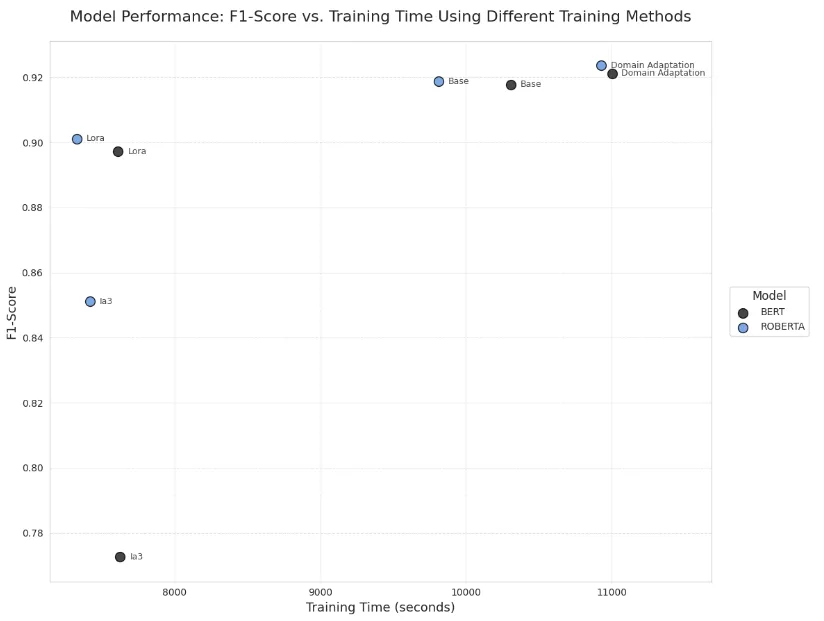
bert-base-uncasedandroberta-base. - Domain adaptation via intermediate masked-language modelling on the Polite Guard corpus pushed RoBERTa to 92.4% F1, matching the dataset's published state of the art.
- PEFT: LoRA cut training time by ~25% for a ~1.9-point F1 drop; IA3 was faster still but degraded more.
Phase 3: prompting LLMs
Llama 3 8B, Mistral 7B Instruct and Gemini 2.0 Flash with zero-shot, few-shot and chain-of-thought prompts scored only 60–70% F1. The fuzzy synthetic label boundaries reward task-specific fine-tuning over general capability.
Results
| Model | Training method | F1 |
|---|---|---|
| RoBERTa | Domain adaptation (MLM) + fine-tune | 0.924 |
| RoBERTa | Full fine-tuning | 0.918 |
| RoBERTa | LoRA | 0.901 |
| SVM | Word2Vec | 0.885 |
| Llama 3 8B | Few-shot chain-of-thought | ~0.70 |
